Electronics · Cold Marking
Laser Marking for Electronics Manufacturing
Fine codes and logos on suitable circuit boards, connectors and coated components. Validate contrast and material integrity on the actual parts.
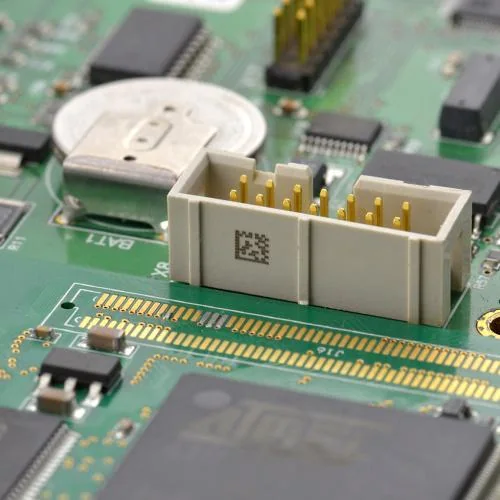
01 — What Can Be Marked
Identification that survives the board process
Part Numbers
Part numbers on IC packages, connectors and housings — legible through conformal coating and reflow processes.
Serial Numbers
Unique serialization per board or component, with automatic sequencing from the marking software.
QR Codes
High-contrast QR codes for board-level traceability, MES uploads and warranty records.
Barcodes
Code 128 and DataMatrix on lead frames, plastic bodies and metal connectors.
Logos
Brand logos and regulatory marks on enclosures, switches and small plastic parts — clean edges at small sizes.
Traceability
Full direct-part traceability — lot, date, line and revision in a single readable field on the board or housing.
02 — Recommended Configurations
Material, requirement, machine, configuration
Typical electronics marking jobs and the configurations we recommend. Confirm on your boards and components with a free sample test.
| Material | Marking Requirement | Recommended Machine | Configuration |
|---|---|---|---|
| FR-4 PCB / Circuit Board | Fine legend + DataMatrix, no delamination | UV 3 W | F160 lens · low pulse energy · XY table |
| ABS / PC Enclosure | Crisp logo + serial, no melt marks | UV 5 W | F160 lens · low power · rotary axis |
| Glass / Ceramic Component | Frosted 2D code, no micro-cracks | UV 5 W | F160 lens · low pulse energy · rotary axis |
| Copper Lead Frame / Connector | Black serial on metal pin area | Fiber 30 W | F160 lens · high contrast · XY table |
| Anodized Aluminum Housing | Color logo marking | MOPA 30 W | F160 lens · pulse-width tuning · rotary axis |
| Plastic Film / Cable Jacket | Batch code on insulation | CO₂ 30 W | F160 lens · low power · conveyor ready |
Specifications are indicative and confirmed during sample testing on your parts.
03 — Process Requirements
Built for SMT lines and clean benches
Electronics marking runs at high volume on small, heat-sensitive parts. The machine must hold micron-level position and contrast without affecting the board, package or component underneath.
-
Cold processing. UV can limit heat effects on suitable materials; melting, bubbling, discoloration and other damage remain possible with unsuitable parameters.
-
Micron precision. Fine line widths and small 2D codes stay readable on lead frames, packages and tight board areas.
-
Line integration ready. Trigger, conveyor and MES signals — standard I/O on every controller for high-volume runs.
-
Clean and residue-free. Fume extraction and enclosed optics keep boards, connectors and sensitive components free of debris.
04 — Relevant Machines
Machines we recommend for electronics
PCBs & Heat-Sensitive Parts
UV Laser
Cold marking on circuit boards, plastics, glass and ceramics — fine detail with no heat damage.
View machine →
Metal & Lead Frames
Fiber Laser
Serials and DataMatrix on copper lead frames, metal connectors and shield cans.
View machine →
Anodized & Aluminum
MOPA Fiber
Dark and contrasting marks on selected anodized enclosures and aluminum housings.
View machine →
Film & Cable
CO₂ Laser
Batch codes on plastic film, cable jackets and polymer packaging.
View machine →
Configure a machine for your line
Tell us the board, component or enclosure, its material and the marking content. We recommend the UV, fiber or MOPA configuration — sample testing confirms the cold mark first.