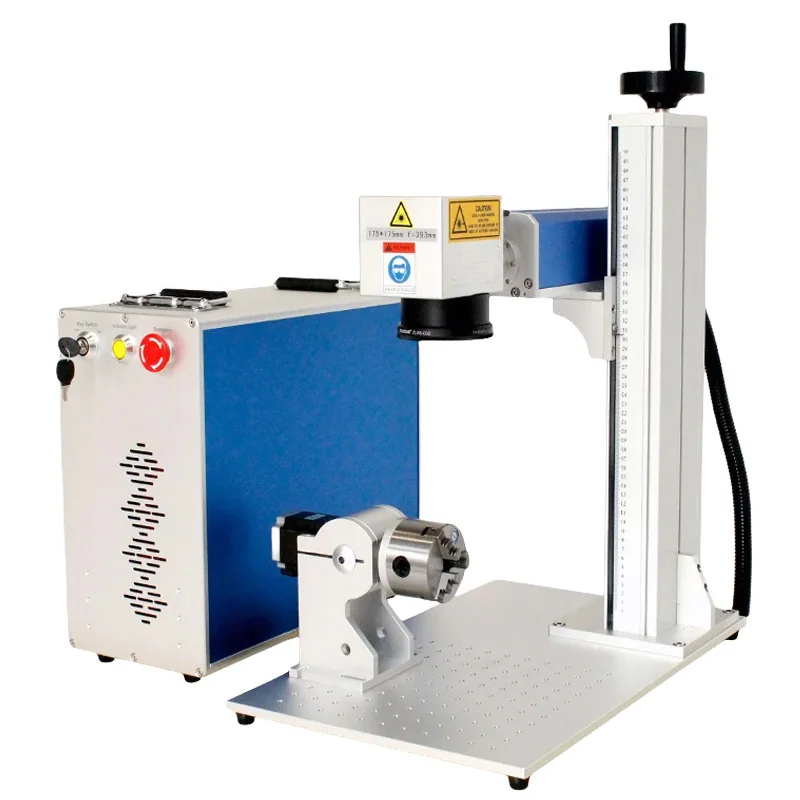
MOPA Fiber Laser Marking Machine
Adjustable-pulse fiber laser for color effects on suitable stainless steel and titanium, dark marks on selected anodized aluminum, and fine metal engraving. 20 W to 60 W.
- Power options
- 20 / 30 / 60 W
- Wavelength
- 1064 nm
- Application
- Pulse control & color effects
Key Specifications
Configuration overview
| Parameter | Specification |
|---|---|
| Laser Wavelength | 1064 nm |
| Laser Type | MOPA pulsed fiber laser; source model specified in quotation |
| Power Options | 20 W / 30 W / 60 W |
| Marking Field | Lens and head dependent; field and working distance specified in quotation |
| Cooling | Air cooling |
| Pulse Width / Frequency | Ranges and permitted combinations depend on the selected source model |
Power options shown are the configurations described in this catalog. The quotation confirms availability, source model, optics, electrical requirements, dimensions and weight. Sample testing establishes achievable contrast, depth and cycle time.
Applicable Materials
Materials to evaluate on your parts
Color effects depend on alloy, finish, oxide-layer conditions and process settings. They are not a universal result on every metal. Plastic and coating compatibility must be tested; PVC and other unsuitable halogen-containing materials are excluded from this general recommendation.
Marking Samples
What MOPA marking looks like
Send your own material for a free sample test and see the result on your part — before any purchase decision.
Available Power
Choose power for the marking task
Fine Work
Jewelry engraving, small electronics, thin coatings and delicate components where heat control matters most.
Balanced Production
The most popular configuration for metal marking, dark anodized-aluminum marking and medium-volume production lines.
High Throughput
Evaluate greater removal rate and throughput on suitable materials; confirm source limits and actual cycle time.
CONFIGURE FOR YOUR PART
Optics, process & production planning
Explore the details that affect mark quality, part access and production cycle.
Choose the field for the marking artwork
Select the field for the size of the actual code or artwork, rather than the overall workpiece size. A larger field can change spot size, energy density and fine-detail performance. Lenses must match the wavelength, scanner and controller calibration.
| Requirement | Selection | What to confirm |
|---|---|---|
| Fine characters or small codes | Evaluate a smaller field | Readable characters, line width and contrast |
| Larger artwork | Evaluate a larger compatible field | Edge quality, focus and achievable cycle time |
| Curved or installed parts | Suitable fixture, rotary or focus arrangement | Surface geometry, positioning and access |
Lens changes require compatible optics, focus adjustment and field calibration. The confirmed field and working distance are listed for the selected configuration.
MOPA: master oscillator, power amplifier
MOPA stands for master oscillator power amplifier. The architecture allows pulse properties to be controlled before amplification. Available pulse-width, frequency, energy and peak-power combinations depend on the specific source; they cannot all be varied without limits.
Pulse settings influence heat accumulation, contrast and material removal. Suitable stainless steel and titanium can develop oxide colors, while selected anodized aluminum can produce dark marks or contrasting layer removal. Color range, repeatability, durability and engraving rate must be verified on representative parts.
At a glance
- ▍Independent pulse width & frequency control
- ▍Color effects on suitable stainless steel and titanium
- ▍Air-cooled, sealed laser source
- ▍Full parameter control in marking software
Evaluate the finished mark and cycle time
Scanner travel speed is not the same as production throughput. Material, artwork, fill spacing, pass count, focus, target depth and loading time determine the finished-part cycle. Request a timed sample using the proposed machine configuration.
| Measure | How to evaluate |
|---|---|
| Scanner performance | Source, scanner, lens and control settings specified together |
| Mark location and repeatability | Validate scanner performance together with fixtures, focus and part loading |
| Production cycle | Time the actual artwork, required passes and handling on representative parts |
Applications
Where the MOPA earns its place
Anodized Aluminum Contrast Marking
Dark or contrasting marks on selected anodized surfaces; results depend on the oxide layer, dye and settings.
Jewelry & Gifts Engraving
Fine engraving on suitable gold, silver and plated pieces, with focus and heat input controlled for the part.
Pens & Keychains
High-contrast personalization on curved metal surfaces using rotary fixtures.
Serial Numbers & DataMatrix
Permanent traceability codes on tools, housings and production parts.
Nameplates & Logos
Deep, durable logos on metal nameplates and enclosures.
Electronics Components
Low-heat marking on connectors, housings and small metal parts.
Optional Accessories
Configure the setup for your application
Options are evaluated for the selected machine and application. Compatibility and included items are confirmed in the quotation.
Rotary or part fixture
Evaluate geometry, load capacity and controller compatibility.
Fume extraction
Select capture and filtration for the materials and process.
Interlocked enclosure
Specify an enclosure for the wavelength and complete configuration; system classification requires assessment.
Focus adjustment
Confirm the required part-height range and mechanism.
Production integration
Confirm sensors, controller interfaces, guarding and cycle requirements.
FAQ
Frequently asked questions
What is the difference between MOPA and standard fiber laser?
MOPA is a fiber-source architecture that can provide broader pulse-width control than many Q-switched sources. The useful pulse-width and frequency ranges depend on the model. This can help control heat input and contrast; it does not make MOPA automatically faster or deeper on every job.
Can a MOPA laser mark colors on metal?
Suitable stainless steel and titanium can develop color effects through controlled surface oxidation. Available shades and repeatability depend on alloy, finish and settings. On selected anodized aluminum, common applications are dark marks and contrasting layer removal. Test the exact surface before specifying a color result.
Which power should I choose?
Evaluate 20 W for fine marking, 30 W for general production and 60 W where greater throughput or removal rate is useful. Check pulse energy, pulse-width options and sample results as well as average power.
Does the machine need water cooling?
The configurations described here use an air-cooled MOPA fiber source. Operating temperature, ventilation and electrical requirements are specified for the selected machine.
What files can the software handle?
Supported vector and image formats, barcode functions and variable-data features depend on the supplied software and controller version. Send your artwork or production data for an import and marking check; the quotation identifies the supplied software and any required license.
How do I test it on my own parts before ordering?
Send representative parts, the material grade and coating details, your marking file, and the required contrast, depth and cycle time. We test the proposed configuration and share the result and process parameters before you order. Start a sample test →
Request a MOPA quotation
Tell us your material, part size, production volume and marking content. We reply with a machine configuration, price and delivery plan.