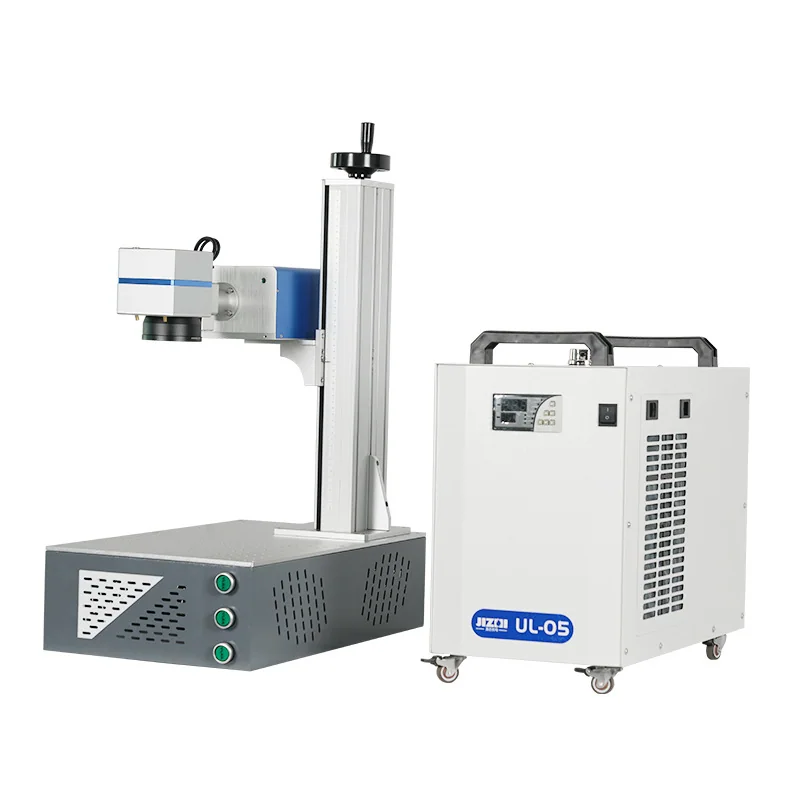
UV Laser Marking Machine
355 nm ultraviolet “cold” laser for ultra-fine, low-heat marking on heat-sensitive materials — plastics, glass, ceramics, silicon and electronics. 3 W to 10 W.
- Power options
- 3 / 5 / 10 W
- Wavelength
- 355 nm
- Application
- Plastics & glass
Key Specifications
Configuration overview
| Parameter | Specification |
|---|---|
| Laser Wavelength | 355 nm |
| Laser Type | UV laser; source model specified in quotation |
| Power Options | 3 W / 5 W / 10 W |
| Marking Field | Lens and head dependent; field and working distance specified in quotation |
| Cooling | Water cooling; chiller specified with the configuration |
Power options shown are the configurations described in this catalog. The quotation confirms availability, source model, optics, electrical requirements, dimensions and weight. Sample testing establishes achievable contrast, depth and cycle time.
Applicable Materials
Materials to evaluate on your parts
Compatibility depends on formulation, coatings and optical properties. Halogen-containing materials such as PVC require a dedicated hazard assessment and suitable extraction; they are not included in this general material recommendation. Medical-device performance and biocompatibility require application-specific validation.
Marking Samples
What marking looks like
Send your own material for a free sample test and see the result on your part — before any purchase decision.
Available Power
Choose power for the marking task
Fine Electronics
PCB, chip and connector marking where heat control and resolution are critical.
Balanced Production
The common choice for plastic, glass and consumer-product marking at production speed.
Higher Throughput
Evaluate higher throughput where the material and process benefit from greater power.
CONFIGURE FOR YOUR PART
Optics, process & production planning
Explore the details that affect mark quality, part access and production cycle.
Choose the field for the marking artwork
Select the field for the size of the actual code or artwork, rather than the overall workpiece size. A larger field can change spot size, energy density and fine-detail performance. Lenses must match the wavelength, scanner and controller calibration.
| Requirement | Selection | What to confirm |
|---|---|---|
| Fine characters or small codes | Evaluate a smaller field | Readable characters, line width and contrast |
| Larger artwork | Evaluate a larger compatible field | Edge quality, focus and achievable cycle time |
| Curved or installed parts | Suitable fixture, rotary or focus arrangement | Surface geometry, positioning and access |
Lens changes require compatible optics, focus adjustment and field calibration. The confirmed field and working distance are listed for the selected configuration.
355 nm ultraviolet: finer light, colder process
A frequency-tripled UV source produces a 355 nm beam. With suitable optics, the shorter wavelength can support fine detail and reduce heat effects on some materials. Marking may involve photochemical and thermal mechanisms; it is not a guarantee of zero heat or zero damage.
The selected source and chiller must meet the required output stability and operating conditions. Fine-line width, minimum readable characters and material integrity are established by testing the actual part and marking file.
At a glance
- ▍355 nm ultraviolet wavelength
- ▍Cold marking with minimal heat affected zone
- ▍Fine spot, high-resolution detail
- ▍Water-cooled sealed UV source
Evaluate the finished mark and cycle time
Scanner travel speed is not the same as production throughput. Material, artwork, fill spacing, pass count, focus, target depth and loading time determine the finished-part cycle. Request a timed sample using the proposed machine configuration.
| Measure | How to evaluate |
|---|---|
| Scanner performance | Source, scanner, lens and control settings specified together |
| Mark location and repeatability | Validate scanner performance together with fixtures, focus and part loading |
| Production cycle | Time the actual artwork, required passes and handling on representative parts |
Applications
Where this machine earns its place
Electronics & Chips
Fine codes on chips, connectors, housings and PCB substrates.
Glass & Crystal
Frosted white marking on glass bottles, crystal and display glass.
Medical Devices
Evaluate identification marks on suitable device components; material integrity and biocompatibility require application-specific validation.
PCB & Wafer Marking
Traceability codes on semiconductor wafers and bare boards.
Cosmetics & Packaging
High-resolution logos and date codes on plastic and glass packaging.
Screens & Displays
Marking on LCD/OLED glass and coated display surfaces.
Optional Accessories
Configure the setup for your application
Options are evaluated for the selected machine and application. Compatibility and included items are confirmed in the quotation.
Rotary or part fixture
Evaluate geometry, load capacity and controller compatibility.
Fume extraction
Select capture and filtration for the materials and process.
Interlocked enclosure
Specify an enclosure for the wavelength and complete configuration; system classification requires assessment.
Focus adjustment
Confirm the required part-height range and mechanism.
Production integration
Confirm sensors, controller interfaces, guarding and cycle requirements.
FAQ
Frequently asked questions
What is “cold” laser marking?
Cold marking describes a process that can limit heat effects compared with some longer-wavelength processes. A 355 nm UV laser can support fine detail on suitable materials, but thermal effects, melting, discoloration or damage remain possible. The process must be tested on the actual part.
Why evaluate UV for plastics?
UV can provide useful contrast and fine detail on some plastics that are difficult to mark with a 1064 nm source. Compatibility depends on the exact resin, additives, pigments, coating and thickness. Neither wavelength is suitable for every plastic.
Can a UV laser mark glass?
UV can produce surface marks on suitable glass and quartz. Appearance and the risk of cracks or chipping depend on composition, stress, geometry, focus and settings. Test representative parts and inspect surface integrity before production.
Why does the UV machine use water cooling?
The configured UV source uses a matched chiller to control temperature and stabilize output. Chiller model, operating conditions and electrical requirements are specified in the quotation.
Which power should I choose?
Evaluate 3 W for fine detail, 5 W for general marking and 10 W where the process benefits from greater throughput. Higher power does not automatically improve contrast or protect sensitive materials. A sample test establishes the settings and cycle time.
How do I test it on my own parts before ordering?
Send representative parts, the material grade and coating details, your marking file, and the required contrast, depth and cycle time. We test the proposed configuration and share the result and process parameters before you order. Start a sample test →
Request a UV quotation
Tell us your material, part size, production volume and marking content. We reply with a machine configuration, price and delivery plan.