Tools & Hardware · Deep Engraving
Laser Marking for Tools & Hardware
Deep engraving and high-contrast marking for cutting tools, fasteners, castings and hardware — serial numbers, logos and part IDs that survive grinding, plating and years of abrasion.
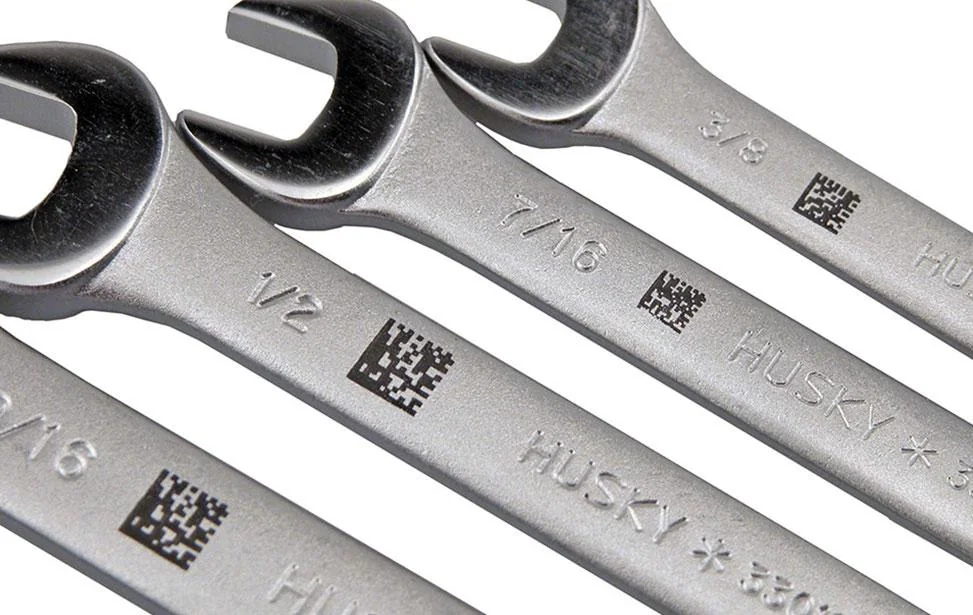
01 — What Can Be Marked
Marks that stay readable through wear
Part Numbers
Deep part numbers on tool bodies, dies and fasteners — readable after grinding, plating and daily use.
Serial Numbers
Unique serialization per tool or batch, with automatic sequencing from the marking software.
QR Codes
QR codes for tool management, inventory tracking and service history on marked metal surfaces.
Barcodes
Code 128 and DataMatrix on bolts, nuts, fittings and tool shanks.
Logos
Brand logos on drill bits, cutting tools and cast housings — high contrast on reflective steel and aluminum.
Traceability
Full process traceability — heat batch, manufacturer date and production line on consumable hardware.
02 — Recommended Configurations
Material, requirement, machine, configuration
Typical hardware and tool marking jobs and the configurations we recommend. Confirm on your parts with a free sample test.
| Material | Marking Requirement | Recommended Machine | Configuration |
|---|---|---|---|
| Carbon / Tool Steel | Deep engraving, 0.1–0.3 mm depth | Fiber 50 W | F254 lens · repeated passes · rotary axis |
| Stainless Steel Tool | Black DataMatrix, high contrast | MOPA 30 W | F160 lens · pulse-width tuning · rotary axis |
| Aluminum Casting / Housing | Black logo + part number | Fiber 30 W | F254 lens · 175 × 175 mm field · XY table |
| Copper / Brass Fitting | High-speed serial marking | Fiber 30 W | F160 lens · high speed · conveyor ready |
| HSS Drill / Cutting Tool | Legible mark on round shank | Fiber 20 W | F160 lens · rotary axis · dust extraction |
| Plastic Handle / Grip | Logo on polymer tool part | CO₂ 30 W | F160 lens · low power · fixture ready |
Specifications are indicative and confirmed during sample testing on your parts.
03 — Durability Requirements
Built for abrasion and heavy use
Hardware marking runs on hard, reflective, often round parts that must stay readable through grinding, plating and years of wear. The machine is tuned for depth and contrast on metal.
-
Deep, durable marks. Repeated passes produce engraving that survives grinding, polishing and electroplating.
-
Contrast on reflective metal. MOPA pulse tuning delivers black, readable codes on steel, aluminum and bright alloys.
-
Round parts handled. Rotary axes mark shanks, drill bits and cylindrical hardware without custom rotation setups.
-
Fast on the line. High-speed galvanometers and conveyor-ready I/O keep up with fastener and consumable volumes.
04 — Relevant Machines
Machines we recommend for hardware
Deep Metal Engraving
Fiber Laser
Steel, tool steel and castings — deep part numbers and high-contrast marks.
View machine →
Black on Reflective Metal
MOPA Fiber
Black DataMatrix and logos on stainless steel, aluminum and bright alloys.
View machine →
Large & Heavy Parts
Portable / Handheld
On-site marking for large dies, heavy hardware and oversized workpieces.
View machine →
Polymer Handles
CO₂ Laser
Logos and codes on plastic grips, handles and composite tool parts.
View machine →
Configure a machine for your parts
Tell us the tool, fastener or hardware piece, its material and the marking content. We recommend the fiber, MOPA or handheld configuration — sample testing confirms depth and contrast first.