Medical Devices · UDI Marking
Laser Marking for Medical Devices
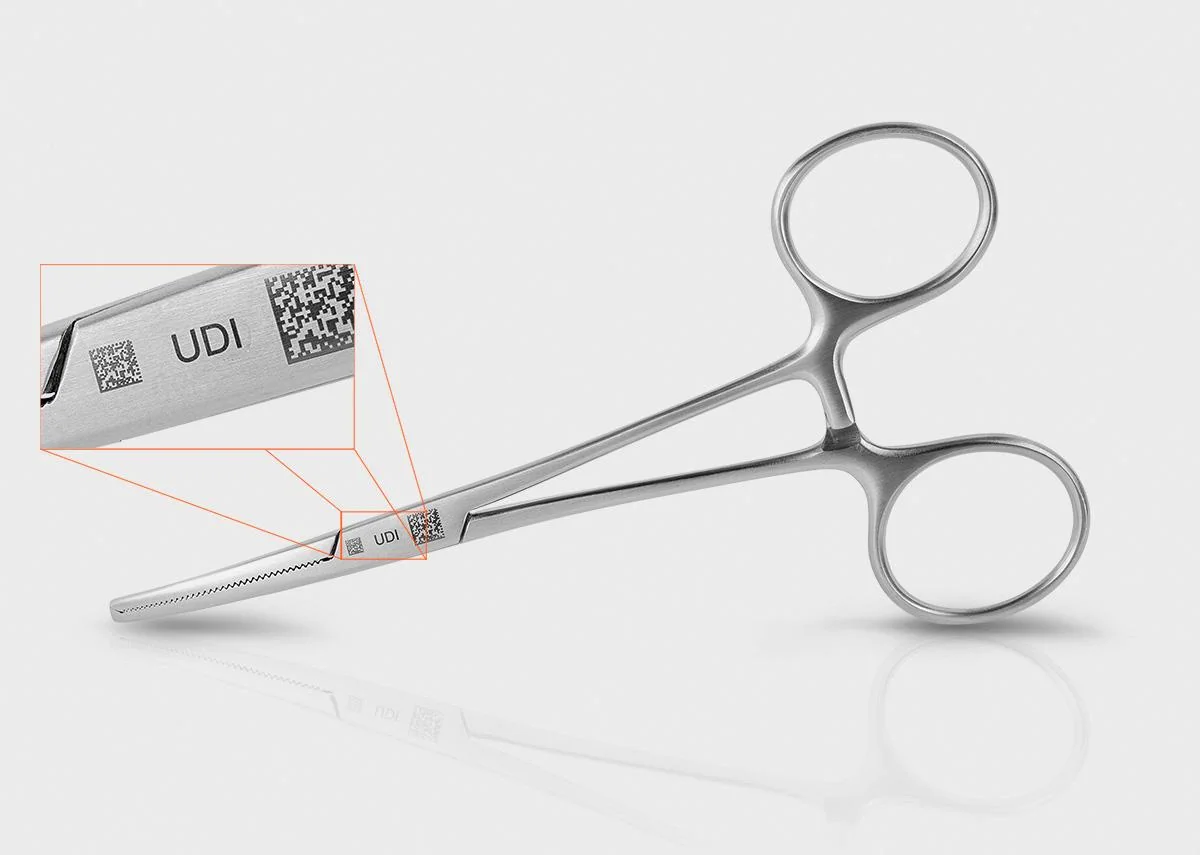
Laser identification for suitable instruments, device components and packaging. UDI readability, corrosion resistance and sterilization durability require validation for the intended use.
01 — What Can Be Marked
Identification that survives sterilization
Part Numbers
Part numbers and catalog codes on instruments, implants and device housings — legible after cleaning and sterilization.
Serial Numbers
Unique serialization per device for UDI and recall tracking, with automatic sequencing.
QR Codes
Permanent DataMatrix and QR codes for UDI, patient safety and regulatory traceability.
Barcodes
Linear and 2D codes on labels, packaging and metal instruments that survive autoclave cycles.
Logos
Manufacturer logos and regulatory marks on stainless instruments and plastic device housings.
Traceability
Full UDI traceability — device ID, production date, lot and sterilization batch in one readable field.
02 — Recommended Configurations
Material, requirement, machine, configuration
Typical medical marking jobs and the configurations we recommend. Confirm on your instruments and devices with a free sample test.
| Material | Marking Requirement | Recommended Machine | Configuration |
|---|---|---|---|
| Stainless Steel Instrument | Black UDI DataMatrix, corrosion resistant | MOPA 30 W | F160 lens · pulse-width tuning · rotary axis |
| Stainless Implant / Housing | Deep part number, no crevice | Fiber 30 W | F160 lens · low-speed passes · rotary axis |
| Glass Vial / Ampoule | Frosted 2D code, no cracking | UV 5 W | F160 lens · low pulse energy · rotary axis |
| Ceramic Component | Fine logo + code, no chipping | UV 5 W | F160 lens · low power · XY table |
| Plastic Device Housing | Crisp logo, no burr | UV 3 W | F160 lens · low pulse energy · XY table |
| Paper / Sterile Pouch | Lot + date code on packaging | CO₂ 30 W | F160 lens · low power · conveyor ready |
Specifications are indicative and confirmed during sample testing on your parts.
03 — Regulatory Requirements
Built for sterile, regulatory-grade parts
Medical-device manufacturers must validate the marking process for the intended material and use, including readability, surface condition, biocompatibility and the required cleaning and sterilization cycles.
-
Sterilization-proof. The mark is part of the material — it survives autoclave, ethylene oxide and chemical cleaning cycles.
-
No contact, no residue. Non-contact laser processing leaves no adhesives, inks or contaminating layers on implants and instruments.
-
UDI-readable by design. 2D DataMatrix codes are tuned for direct-part machine readability and scanning reliability.
-
Clean-room friendly. Enclosed optics, fume extraction and documented parameters support controlled production environments.
04 — Relevant Machines
Machines we recommend for medical devices
Glass, Ceramic & Plastics
UV Laser
Cold, frosted marking on glass vials, ceramic and heat-sensitive device housings.
View machine →
Black UDI on Steel
MOPA Fiber
Permanent black DataMatrix on stainless instruments and implants — readable after sterilization.
View machine →
Deep Metal Engraving
Fiber Laser
Deep part numbers and catalog codes on stainless surgical instruments and implants.
View machine →
Packaging & Labels
CO₂ Laser
Lot and date codes on sterile pouches, paper labels and device packaging.
View machine →
Configure a machine for your devices
Tell us the instrument, implant or package, its material and the UDI content. We recommend the UV, MOPA or fiber configuration — sample testing confirms the permanent mark first.