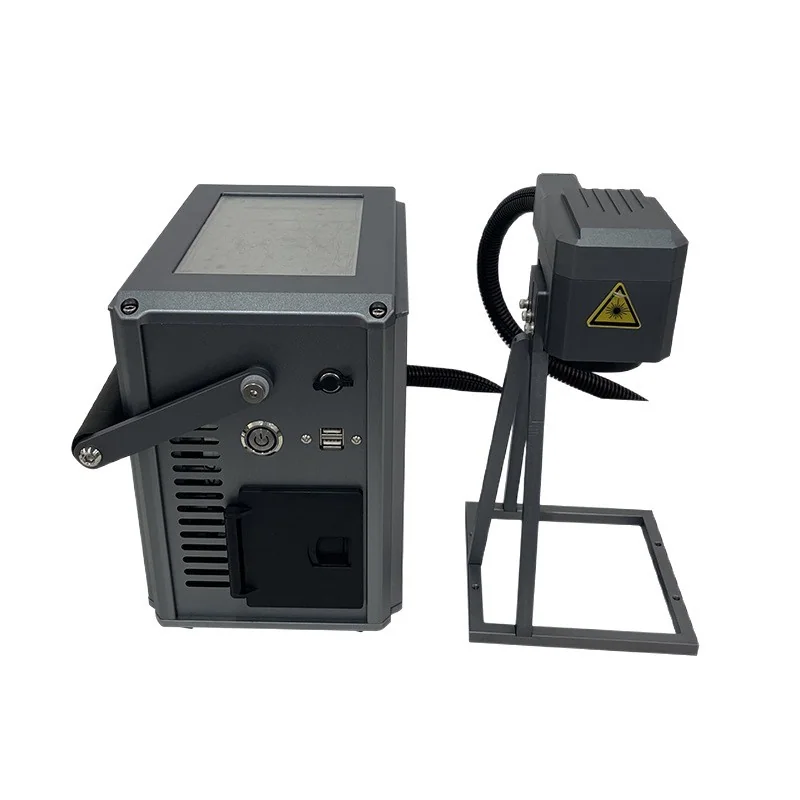
Handheld Laser Marking Machine
Portable handheld laser marker for on-site marking on large, heavy or fixed workpieces. 20 W to 50 W fiber configurations; site setup and supply requirements depend on the selected model.
- Power options
- 20 / 30 / 50 W
- Wavelength
- 1064 nm
- Application
- Large & installed metal parts
Key Specifications
Configuration overview
| Parameter | Specification |
|---|---|
| Laser Wavelength | 1064 nm |
| Laser Type | Pulsed fiber laser with handheld marking head |
| Power Options | 20 W / 30 W / 50 W |
| Marking Field | Lens and head dependent; field and working distance specified in quotation |
| Cooling | Air cooling |
| Head / System Weight | Specified separately for the selected configuration |
| Power Supply | Supply and any battery option must be confirmed for the selected model |
Power options shown are the configurations described in this catalog. The quotation confirms availability, source model, optics, electrical requirements, dimensions and weight. Sample testing establishes achievable contrast, depth and cycle time.
Applicable Materials
Materials to evaluate on your parts
Typical workpieces include pipes, frames and large installed metal parts. Exact alloy and coating must be tested. Marking on vehicles, pressure vessels or other critical parts must meet the part owner’s specifications and approved process requirements.
Marking Samples
Handheld operation demonstration
This video illustrates the operating format. Ask for a test on your own part to confirm the marked result, positioning method and cycle time.
Available Power
Choose power for the marking task
Portable & Lightweight
Light marking and date codes on metal parts, ideal for on-site work and small jobs.
Balanced Production
The common choice for on-site marking on pipes, steel structures and large workpieces.
Deep Engraving
Evaluate greater removal rate on suitable metals; required depth and cycle time must be tested.
CONFIGURE FOR YOUR PART
Optics, process & production planning
Explore the details that affect mark quality, part access and production cycle.
Match the marking head to the job
The marking field and working distance must match the handheld head, lens and positioning adapter. A large workpiece does not require an equally large marking field; specify the size of the actual code or logo.
| Requirement | Selection | What to confirm |
|---|---|---|
| Fine characters or small codes | Evaluate a smaller field | Readable characters, line width and contrast |
| Larger artwork | Evaluate a larger compatible field | Edge quality, focus and achievable cycle time |
| Curved or installed parts | Matched head adapter or fixture | Surface geometry, positioning and access |
Lens changes require compatible optics, focus adjustment and field calibration. The confirmed field and working distance are listed for the selected configuration.
1064 nm fiber: built for portability
The 1064 nm pulsed fiber source can alter or engrave suitable metal surfaces. A handheld head lets the operator position the optics at the part, subject to the connection cable, access and working distance. Mark depth and appearance depend on material and process settings.
The configured source is air-cooled. Operation requires the specified electrical supply, correct focus and suitable controls for direct and reflected laser exposure. Portability does not establish cordless operation or suitability for unrestricted outdoor use.
At a glance
- ▍1064 nm fiber laser wavelength
- ▍Handheld head for site marking with a controlled setup
- ▍High-speed galvanometer scanning
- ▍Air-cooled operation
Evaluate the finished mark and cycle time
Scanner travel speed is not the same as production throughput. Material, artwork, fill spacing, pass count, focus, target depth and loading time determine the finished-part cycle. Request a timed sample using the proposed machine configuration.
| Measure | How to evaluate |
|---|---|
| Scanner performance | Source, scanner, lens and control settings specified together |
| Mark location and repeatability | Validate head placement, fixture stability, focus and scanner performance |
| Production cycle | Time the actual artwork, required passes and handling on representative parts |
Applications
Where this machine earns its place
Steel Pipe Marking
On-site batch codes and logos on steel pipes, tubes and pipeline sections.
Large Steel Structures
Part numbers and identification marks on steel beams, frames and construction components.
Heavy Machinery
Permanent marks on large engines, gearboxes and heavy equipment that can't be moved.
Automotive Chassis
Part identification on frames and chassis where the part owner has approved the marking process and specification.
Storage Tanks
Marking on large tanks, vessels and containers in industrial facilities.
On-Site Maintenance
Quick on-site marking for repair, maintenance and asset identification work.
Optional Accessories
Configure the setup for your application
Options are evaluated for the selected machine and application. Compatibility and included items are confirmed in the quotation.
Positioning adapter or fixture
Confirm geometry, focus and compatibility with the selected head.
Local fume extraction
Select extraction for the material and worksite conditions.
Laser exposure controls
Confirm shielding, operating area and controls for direct and reflected beams.
Cable reach and transport
Confirm head connection length, control-unit placement and transport arrangement.
FAQ
Frequently asked questions
Why choose a handheld marker?
Choose a handheld head when the part cannot be brought to a bench machine. Check access, connection-cable reach, focus, head positioning, electrical supply and the ability to establish a controlled laser work area at the site.
Is handheld marking as accurate as a bench setup?
Scanner repeatability does not describe the accuracy of manually positioning a head. Part movement, tilt, focus, contact geometry and operator technique affect the result. Use a suitable fixture or contact adapter and validate code quality and location on representative parts.
Does the machine run on a battery?
The quotation must confirm the selected model’s power supply. Battery operation, cordless use, capacity, runtime and charging time are not specified on this page. If battery operation is required, request confirmation and a test under your expected duty cycle.
How much does the system weigh?
Head weight and total transport weight are different specifications. The quotation should state the head, control-unit and complete-system weights separately, along with cable reach and transport accessories.
Which power should I choose?
Evaluate 20 W for routine identification, 30 W for general site marking and 50 W where greater removal rate is needed. A stable setup and sample test are required to establish depth and cycle time; workpiece thickness alone does not determine the power.
How do I test it on my own parts before ordering?
Send representative parts, the material grade and coating details, your marking file, and the required contrast, depth and cycle time. We test the proposed configuration and share the result and process parameters before you order. Start a sample test →
Request a Handheld quotation
Tell us your material, part size, production volume and marking content. We reply with a machine configuration, price and delivery plan.